Zimmer: Focus on Soil Biology
Focus on Soil Biology.
Let's repeat that again ..... soil biology. That's the message that Garry Zimmer, legendary regenerative farmer and consultant gave in his key note address at the recent Acres, 2020 Eco Ag conference.
This is very encouraging for Telopea Group as, despite having traveled a very separate path, we have ended up at the same point of focus as a leader of the regenerative agriculture movement. That point is about realising the importance of soil biology, specifically the role that microbes play in sustaining, enhancing agricultural production.
This vindicates the efforts Telopea Group have made and continue to make to research and develop our biological soil supplements and an associated industry to support farmers to use these soil ameliorates to enhance the health of their soils.
Living Soil
Soil is a living organism and it needs to be respected as such.
On part of our journey of discovery of the importance of soil biology and regenerative farm practices, Telopea Group have encountered farmer's in Australia who have started to adopt these new systems and are reaping great benefit by enhancing the living health, the biology, of their soils.
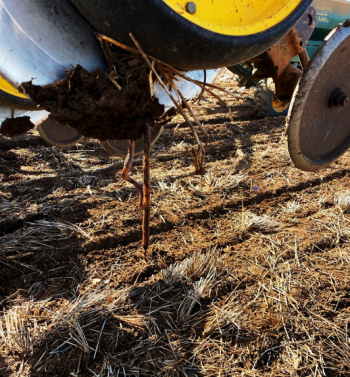
The worm caught on the disc, as illustrated in the picture, is an indicator of soil health.
After only two seasons newly introduced regenerative agricultural practices have enabled the worms to return to what was previously a under-performing paddock. This is an important sign given the position in which worms sit in the soil ecosystem and the part they play in enhancing fertility and improving soil structure.
This result has been achieved by employing regenerative agricultural practices including the retention of crop residues, employing gps-traffic-controlled machinery, engaging minimal till minimal disturbance farming methods, adding organic based supplements at the time of sowing, performing plant sap testing and careful soil management.
Regenerative farming practices have helped to improve soil structure and fertility, increase organic matter and associated carbon, better retain moisture, improve plant growth and resilience, increase crop production and reduce farm input costs by 55% through lowering reliance upon synthetic fertilisers and chemicals.
Now what is really interesting is that these farmers who are adopting these new regenerative farming practices are, on the advice of their agronomist applying molasses, which is rich in sugars, directly to their fields in an attempt to stimulate the soil biology and so gain all the benefits we have looked at previously.
Zimmer: Molasses!
Gary is incredibly knowledgeable about soils and regenerative farming ..... and a bit difficult to keep up with too given his enthusiasm for soils. However, when slowed down Gary revealed something that ought make many farmers in Australia take note. Here is a transcript of the very important message that he gave after his presentation that highlighted the importance of focusing on soil biology, especially with respect to the derived benefits of enhancing soils by improving structure, increasing organic matter and sequestration of carbon to improve resilience and reduce risks associated with drought and flood.
Interviewer's question:
What do you suggest to remediate clay aging in soils?
Gary Zimmer's response:
Now sand and clay teach really good farmers because they are not easy to deal with. Sand you need lots of inputs and clays you have to be be really careful, you can really mess up clay.
The more roots you got in there the better the drainage, [then] I've got [lack of] water issues. Dakota on these heavy soils I've got 60-70 CEC, high clay, low rainfall, high potassium and high pH .... it's really challenging.
I think .... putting a liquid ....
we use a molasses based fertiliser
and a biological, right down to the [plant root] level. I gotta feed and stimulate the roots, start as close to the plant as possible.
That clay is hard, I cant grow a big root system. [I] must get a root stimulant, near the see and some biology to grow some roots. There are plenty of minerals there ... the tightness of the clay soil that's the problem. You gotta get a biological down there.
Organic: Molasses
Molasses, a highly viscous by-product of sugar refinement, is a great supplement for improving your soils and plants vitality. Molasses is rich in both micro- and macro- nutrients, is a great source of carbohydrates for soil microbes, and subsequently boosts the structure and moisture retention of the medium, and encourages growth of beneficial organisms.
Molasses also aids in the reduction of salt build up, which is a common cause of nutritional problems, and is a useful insect repellent. While microbes thrive on the sugars in molasses, ingesting molasses for an insect may be fatal Molasses is often used as part of a regular feeding schedule, in foliar sprays, composts and compost teas, and during soil preparation. The benefits of molasses will be most noticed during the flowering period. Molasses can also be added/combined with other organic liquid fertilizers and sprays, such as compost teas, kelp, alfalfa, and milk.
Molasses or sugars can provide readily available energy to microbes that take up nitrogen into their tissues, thus increasing the nitrogen loving bacteria and creating a “nitrogen sync” in the soil, to slow down leaching.
The Farm as Ecosystem, Tapping Natures Reservoir - Biology, Geology, Diversity. Brunetti, J. 2014, p37
Milk as an Organic Fertiliser and Pesticide
• University of Nebraska
• Extension and Certified Holistic Management Educator Terry Gompert,
• Charles Shapiro, professor of agronomy and horticulture soil scientist,
• Stevan Knezevic, herbicide specialist, and
• Nebraskan Farmer, Dave Wetzel
The University researchers created a summer experiment in conjunction with Wetzel.
The design tested five different treatment rates from zero to 32 gallons of raw skim milk per acre. The different levels were mixed with water so that each 100 foot by 10 foot plot received equal amounts of liquid. Each application was replicated on four plots.
Additional variations were created with the use of Wetzel's other byproduct of cod liver oil. Either 4 ounces of oil per acre were added to the milk or the milk was applied separately.
"Essentially 10 different applications were replicated four ways," he explains. "In the test, the skim milk was taken out of the tank, it was mixed and everything was put on the land within an hour. It was very alive material."
The milk and milk mixtures were applied to the diverse grass and legume fields as a foliar application.
The hypothesis: Lactobacillus from the milk would combine with fungi from the fish emulsions to feed active soil bacteria, thus creating a fertilizer source for the irrigated, well-established pasture.
Forty-five days after the application, the fields were harvested and yields were measured. The plots without milk or oil provided 4,454 pounds of dry matter. Fields drenched with 2 gallons of milk yielded 5,578 pounds. The plots with milk plus oil had slightly higher yields, but results were sporadic.
"The highest advantage we saw was at 2 gallons per acre," Gompert emphasizes. "An extra 1,124 pounds [per acre] from one application is quite significant. It's more than we get from adding nitrogen or phosphorous from the local coop." The team was most surprised that 2 gallons of milk ignited a greater reaction than higher application levels.
"It didn't make any difference if we gave 2 or 32 gallons of treatment," he adds. "Two gallons of milk increased yield by 26 percent; Wetzel cod liver oil increased yield by 20 percent; together, they increased yield by 31 percent. That's on one harvest; we don't even know about the long-term benefits."
The researchers then used a penetrometer to see if there were any differences in soil compaction.
"We did three tests at different levels at each of the plots to see the relative softness of the land 45 days after the application," he says. "Essentially, we did 12 samplings and averaged the readings for pounds of pressure at 6, 12, 18 and 24 inches."
The fields applied with only oil were 9 percent more porous than the plots with no application. Meanwhile, the porosity of plots fertilized with milk was 18 percent softer than the control. The milk plus oil application had too much variation for direct conclusions.
The increased porosity is closely correlated with higher yields and could have long-term affects on plant health, Gompert indicates.
"If we have more porosity, we are increasing water-holding capacity and air," he says. "Those are the two requirements to grow roots, carbon and microbes."
"The data does lead to more questions," "How often should it be applied and with what method? When is the best time for application? When should the crops be harvested?"
The type of milk used does not appear to be an issue, however. "We used skim milk on our study, but whole milk seems to work equally well," he says. "It's almost like it doesn't matter what form it's in as long as it gets into the soil. If it turns out to be a microbial benefit, you would want to use unpasteurized milk."
From
Milk and molasses microbial recipes
Recipes
To be safe, using a starting point of 1 tablespoon (15 ml) of molasses per gallon (3.8 liter) of water for feedings is a good rule of thumb For use as an insecticidal foliar spray, 1 teaspoon (5ml) per gallon is recommended.*Mix molasses in lukewarm water before adding to reservoir, bucket, or spray bottle to allow it to fully dissolve. The benefits of molasses will be most noticed during the flowering period. Molasses can also be added/combined with other organic liquid fertilizers and sprays, such as compost teas, kelp, alfalfa, and milk.
Sweet Weed Control
A fringe benefit of spraying the milk and molasses mixture on the garden is a biologically friendly weed population control. Many broadleaf weeds thrive on diets high in available nitrates and potassium diets, common with commercial fertilizers. Phosphorus is “tied up” or bound with calcium in the soil and needs biological activity to release it. The calcium in milk helps to compensate for what is unavailable in the soil, while the increased biological activity from both the milk and molasses releases unavailable phosphorus and create soil conditions that are unfavorable to germination of weed seeds.
BSOP
Economics
Telopea Group have designed a multipurpose plant to mix our brews and deliver them on a scale to achieve the economies of scale to reduce the cost of supplying this important farm input.
The costs of applying the milk and molasses mixture is very minimal, but when compared to any other fertilizer and insecticide regimen – even those that are organic in nature – milk and molasses has no comparison.
Inputs like organic molasses, filtered water, organic milk, organic fish emulsions and seaweed and other ingredients are mixed in the plant and then spread upon fields, crops and pastures, using conventional machinery or drones.
Composting
Composting Johtson-Su Reactor